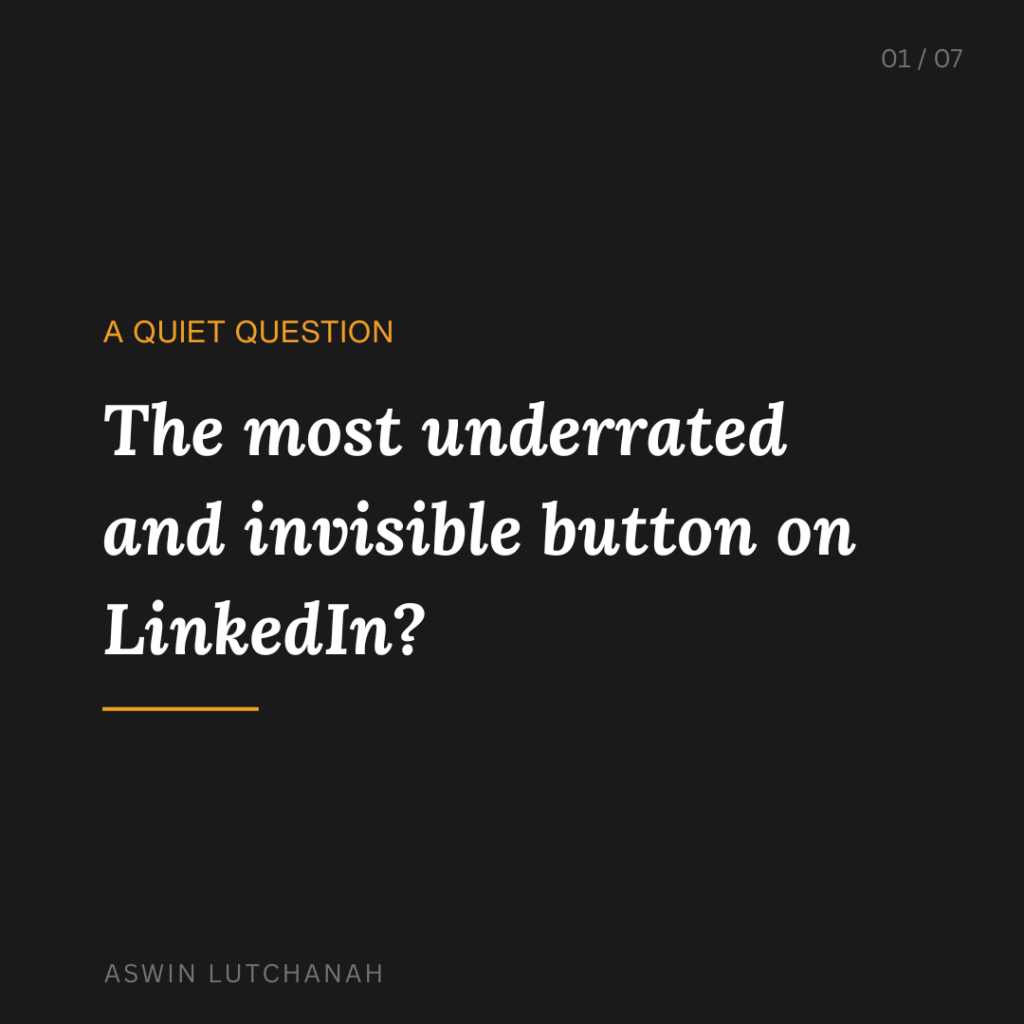
Why saves matter more than likes, and what they reveal about the future of social media.
There is a button on LinkedIn most people never notice. It hides behind three small dots in the top right corner of every post. It makes no sound when you press it. It sends no notification to the person who wrote the post. It does not appear under your profile picture for anyone else to see.
And yet, in 2026, it might be the most important button on the platform.
It is the Save button.
This is the story of how a quiet feature became one of the loudest signals in social media, and why the people building real reputations on LinkedIn are paying attention.
What changed in late 2025
For years, LinkedIn measured engagement in the obvious ways. Likes. Comments. Shares. Reposts. The metrics most platforms have used since the early days of social media. The metrics every marketing dashboard knows how to display.
In late 2025, something quietly shifted. LinkedIn officially added two new metrics to post analytics: Saves and Sends.
It looked like a small interface update. It was not.
By making saves visible to creators, LinkedIn was telling everyone something important. The platform had decided that saving, the act of bookmarking a post for later, was a stronger signal of value than reacting to it. The algorithm had been treating saves this way for some time. The interface change made it official.
Most people missed the news. The few who noticed wrote about it briefly, then moved on. Even now, months later, the average LinkedIn user does not know the save button exists. The average creator still optimises for likes and comments without thinking about what people are quietly keeping.
That gap is where the opportunity lives. The space between what the algorithm rewards and what most creators are doing.
The hierarchy of LinkedIn signals in 2026
Not all engagement is created equal. The 2026 algorithm reads each interaction as a different kind of signal, and weighs them accordingly.
Likes are loud. They take a second to give. They cost the giver almost nothing. The algorithm reads them as “this caught my eye,” which is useful but shallow.
Comments are conversational. They take effort. They reveal the commenter’s perspective, expertise, or interest. A meaningful comment, one that adds context, shares a related experience, or asks a thoughtful question, carries far more algorithmic weight than a like.
Shares show that someone wants their network to see this too. They put the sharer’s reputation on the line. The algorithm rewards them, but cautiously, because not all shares are about quality (some are about social signalling).
Saves are different. A save says: “I want to come back to this.”
Nobody saves something they do not value. There is no social pressure to perform. There is no notification to game. The action is private, deliberate, and durable. It signals that the post has lasting use, not just momentary appeal.
This is why the algorithm is paying attention. In 2026, LinkedIn is trying to filter out the noise of viral-but-empty content and elevate posts that genuinely help people. Saves are the cleanest signal of that.
What saves tell you that other metrics cannot
Reactions tell you what catches attention.
Comments tell you what sparks conversation.
Saves tell you what people quietly need.
The third one matters most. Catching attention is easy. Sparking conversation is harder. Meeting a real need, making something useful enough that someone wants to keep it, is the work that builds long-term trust.
A post can collect hundreds of likes and reveal nothing about whether it was useful. A post that gets quietly saved by even a few dozen people has been judged worth keeping by an audience with no reason to lie. That judgement is the truest form of feedback a creator can receive.
Quiet need is loyalty in slow motion.
How to save a post (in case you have never used it)
Open any LinkedIn post. Tap the three dots in the top right corner of the post. A menu appears. Choose Save.
That is it. The post is now bookmarked.
To find your saved posts, go to your profile menu and look under Saved items / Saved posts. They are stored there indefinitely, in reverse chronological order. You can revisit them whenever you want, and there is no limit to how many you can save.
The author of the post is never notified. There is no public record. The save is yours alone, quiet by design.
This privacy is the feature, not the limitation. People save things they would never publicly endorse. They save articles they want to read again, frameworks they want to remember, posts they want to forward to a colleague next week. The save button reveals what people actually find useful, not what they want others to think they find useful.
What this means if you create on LinkedIn
If your posts get saved often, you are building something different from what most creators are building. You are not building a feed. You are building a library.
Most LinkedIn content is feed content. Designed to scroll past, react to, and forget by the next morning. It serves a moment, then disappears.
Library content is different. It is designed to be returned to. To be screenshot. To be sent in a DM weeks later when a colleague asks for a recommendation. To be referenced in someone’s own thinking long after the original post has scrolled into oblivion.
Library content includes things like:
- Practical frameworks people will want to apply later
- Specific lessons from real experience, told concretely enough to remember
- Resource lists, checklists, or playbooks worth keeping nearby
- Honest reflections that articulate something the reader had been feeling but could not name
It does not include things like:
- Generic motivational posts that say nothing specific
- Reaction-bait questions designed to harvest comments
- Hot takes that exist mainly to provoke
- Updates without insight (“had a great meeting today”)
The first kind builds a quiet, durable reputation. The second kind disappears the moment the algorithm stops promoting it.
If you want to build a long-term presence on LinkedIn, ask yourself a different question before you publish: would someone want to keep this?
Why this matters more in 2026 than ever
Three things have changed about LinkedIn in the last year, and they all point in the same direction.
First, the algorithm has shifted from rewarding “viral reach” to rewarding what LinkedIn officially calls “Depth and Authority.” Posts that earn deep engagement signals (saves, dwell time, meaningful comments) get distributed more widely than posts that earn shallow ones, even when the shallow posts have more likes.
Second, AI search engines like Perplexity, ChatGPT, and Gemini are increasingly indexing LinkedIn as a source of expert thought. When someone asks an AI a question about marketing, B2B strategy, or workplace trends, the AI often quotes LinkedIn posts and articles. The posts most likely to be cited are not the loudest ones. They are the ones with substance, structure, and signs of reader engagement that suggest lasting value.
Third, audiences are exhausted by the AI-generated content flood. Every week, more LinkedIn feeds fill with templated posts, recycled hot takes, and generic “lessons from a meeting today.” The signal-to-noise ratio is collapsing. The posts that stand out are the ones that feel like they were written by a real person who knew something specific.
In all three of these shifts, the save button is the connecting thread. Saves filter for quality. Saves reward substance. Saves reveal what people genuinely care about beyond the reactive impulse of the scroll.
A small invitation
The next time you scroll past a post that genuinely makes you think, save it.
You are doing two quiet things at once.
You are telling LinkedIn’s algorithm that this kind of content matters to you, which means more of it will appear in your feed over time. You are training the system to surface depth rather than noise.
You are also telling the person who wrote the post, through the analytics they will see later, that their thinking landed somewhere. That it was worth keeping. That the work was worth the time it took to make.
Quiet buttons build the loudest reputations.
The algorithm is learning what you care about. So is the person who wrote it.
Smile. Create. Inspire. ?
Take Care,
Your fav Social Media Manager ☀️
Aswin