Ever since the two vowels of my first name decided to take over the world, I have been fascinated by them.
I have spent a lot of money on this thing, too.
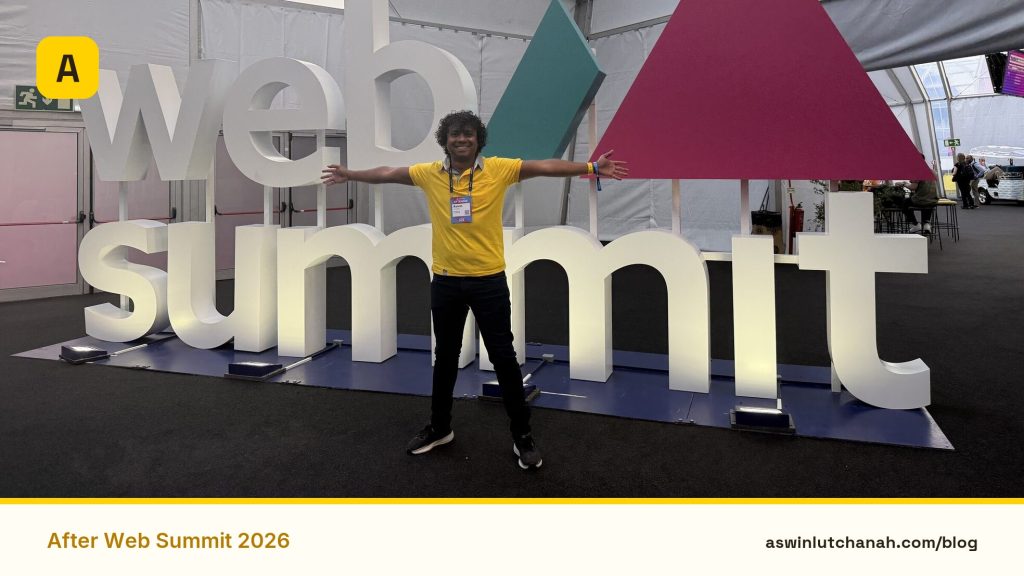
In November I came to Lisbon for Web Summit, thanks to my employer, the University of Luxembourg.
I am still in Lisbon, enjoying a few days off. Web Summit left me with two takeaways, one storm, and a handful of photographs I did not know existed.
Monday: the robots danced first
Opening night at the MEO Arena began with nine robots dancing in step.
Then Paddy Cosgrave, the founder of Web Summit, said:
“The superstars of the future are not coming from California; they’re coming from China.”
Paddy Cosgrave, as reported by Euronews
At Web Summit I saw robots with smooth movements, dancing in style, covered in something like skin. Silicone, or whatever the material was.
Hold that picture. I will come back to it.
Tuesday: a slide and a wall
Two things stayed with me from Tuesday.
The first was a slide from Don McGuire of Qualcomm. Two short lists. Humans need trust, emotional connection, relevance. Agents need access to data, reasoning, context.
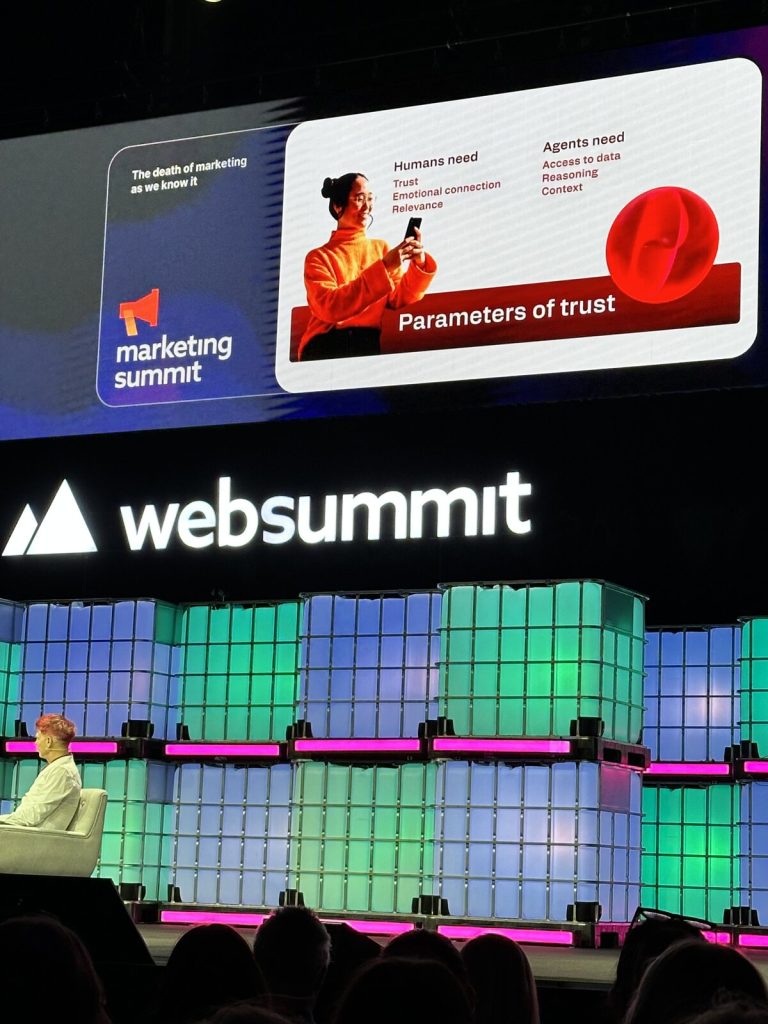
So people who do my job now write for two readers. And one of them is not human.
The second was a black wall covered in yellow dots. You will understand why I stopped.
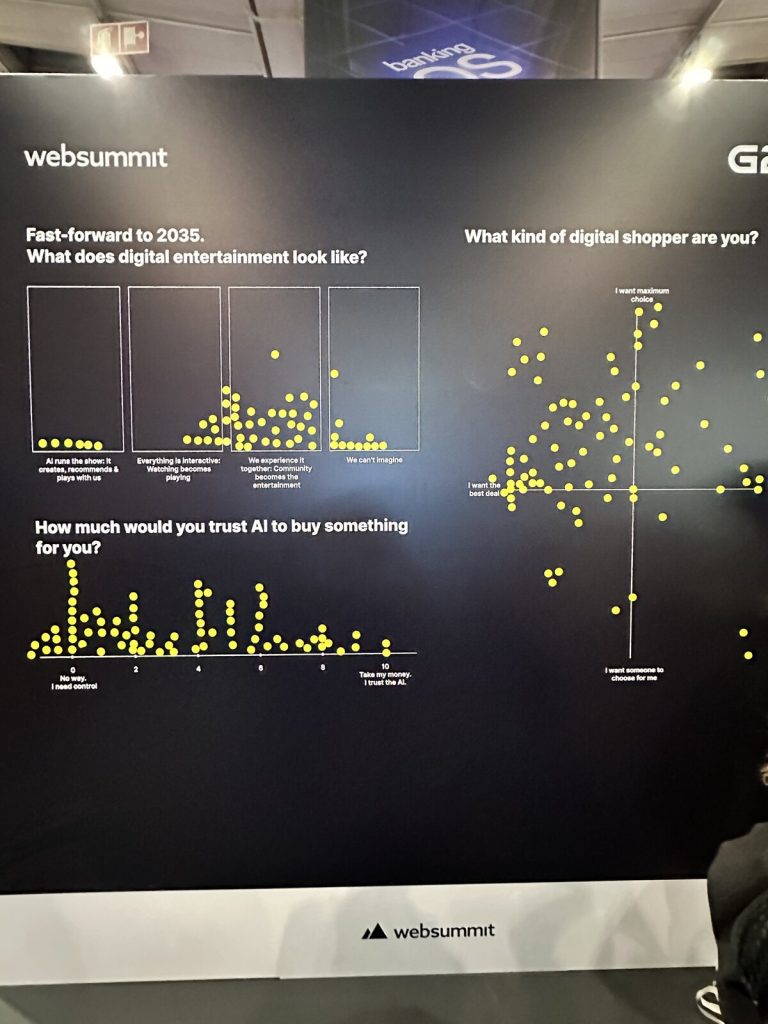
It asked: “How much would you trust AI to buy something for you?” Zero meant “No way. I need control.” Ten meant “Take my money. I trust the AI.”
The tallest column of dots stood at zero.
Wednesday: the wind had the last word
Then came Storm Charles.
On Tuesday evening an email arrived. Day 2 would not take place. The Portuguese government had advised against it: tidal flooding, public transport, high winds. Schools were closed across the country.
Some 70,000 people had come to Lisbon to hear that software will soon decide things for us. For one day, the deciding was done by the wind and a river.
Thursday: “How many do you already know?”
Web Summit reopened on Thursday with Wednesday squeezed inside it. The organisers billed it as the busiest Thursday ever.
On the Marketing Summit stage, a session called “China’s global brand revolution” put up one slide with one question.
“How many do you already know?”
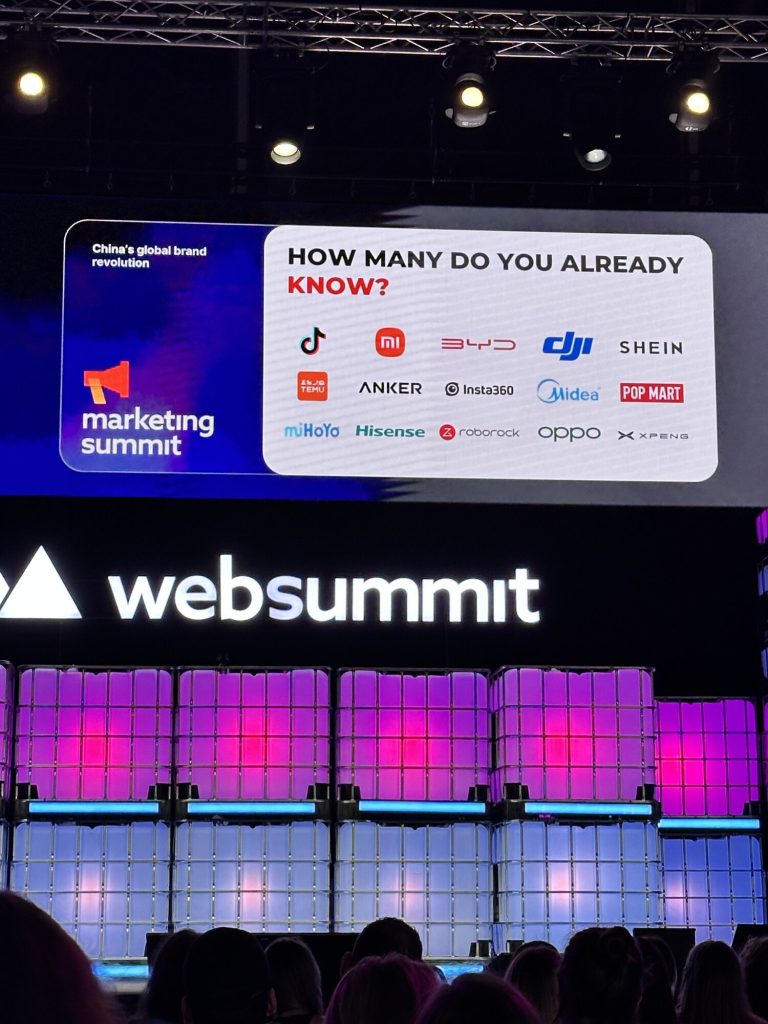
TikTok. Xiaomi. BYD. DJI. Shein. Temu. Anker. Insta360. Midea. Pop Mart. miHoYo. Hisense. Roborock. Oppo. Xpeng.
You probably know most of them. That was the point.
A few halls away, a Hisense fridge had a screen on its door, showing what was inside without anyone opening it. Even the fridge is watching now.
And one more slide, from the Creative Summit, in a session asking whether AI actually knows what people want:
“So we can build beyond what people will merely accept and toward what’s genuinely worth their attention.”
That is the job description. If we still have one.
What Web Summit 2026 confirmed
Two things.
One. Yes, we will lose our jobs as we know them. The sooner we accept it, the better.
What I do not know is how.
Maybe the IKEA way. When its chatbot took over the routine questions, IKEA’s owner retrained around 8,500 call-centre workers as interior design advisers instead of letting them go.
Or maybe it will be brutal.
And if it is brutal, the brutal part will come after. After we have been used to feed these systems with our knowledge and our savoir-faire.
Two. The Chinese models are ruthless.
Let me say this loud enough: I am not an AI expert. I am a passionate person. An enthusiast, or whatever bullshit LinkedIn-friendly title you want to give me.
But as a user, China is way ahead.
We can focus, as usual, on policies. Good AI, bad AI. That, I leave to you.
Reality will take care of everything, as usual.
We are doomed. Admit it or not.
Yes, AI is making everything easier and quicker.
Of course, we look for excuses. It makes mistakes, we say.
It does. It makes fewer and fewer, and it is getting better very fast.
Remember the robots? Smooth, in style, wearing skin.
We are doomed. Admit it or not.
And then, the photographs
Days later, some photos arrived.
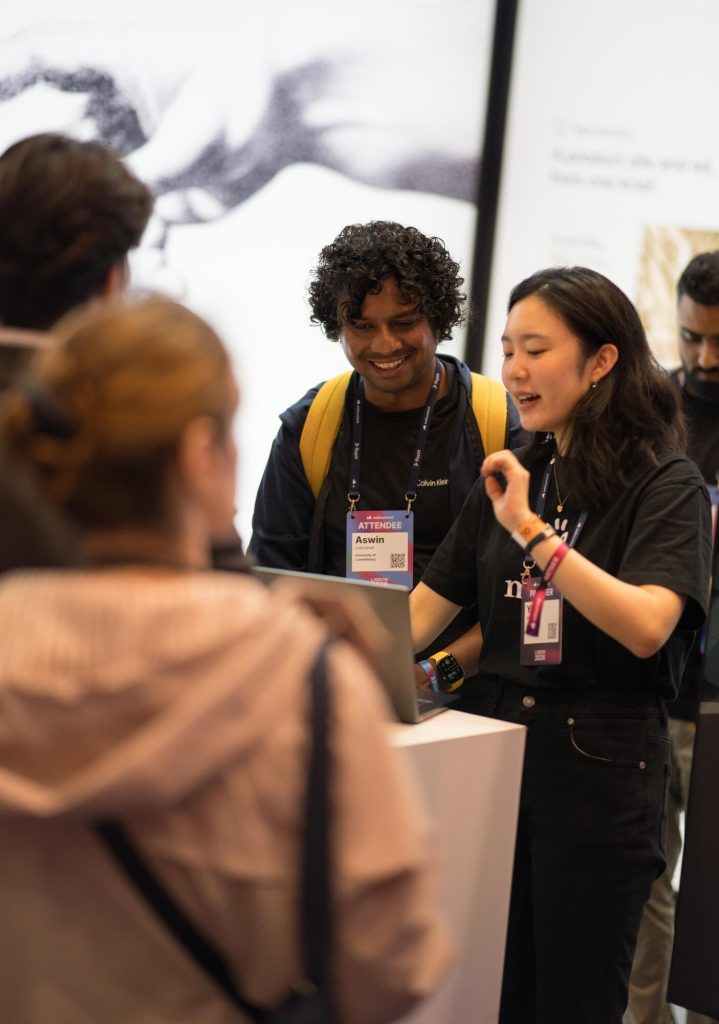
In them I am deep in conversation, my yellow backpack on my shoulders, badge around my neck. In one, my hands are pressed together. In another, I am smiling.
I did not know anyone was taking them.
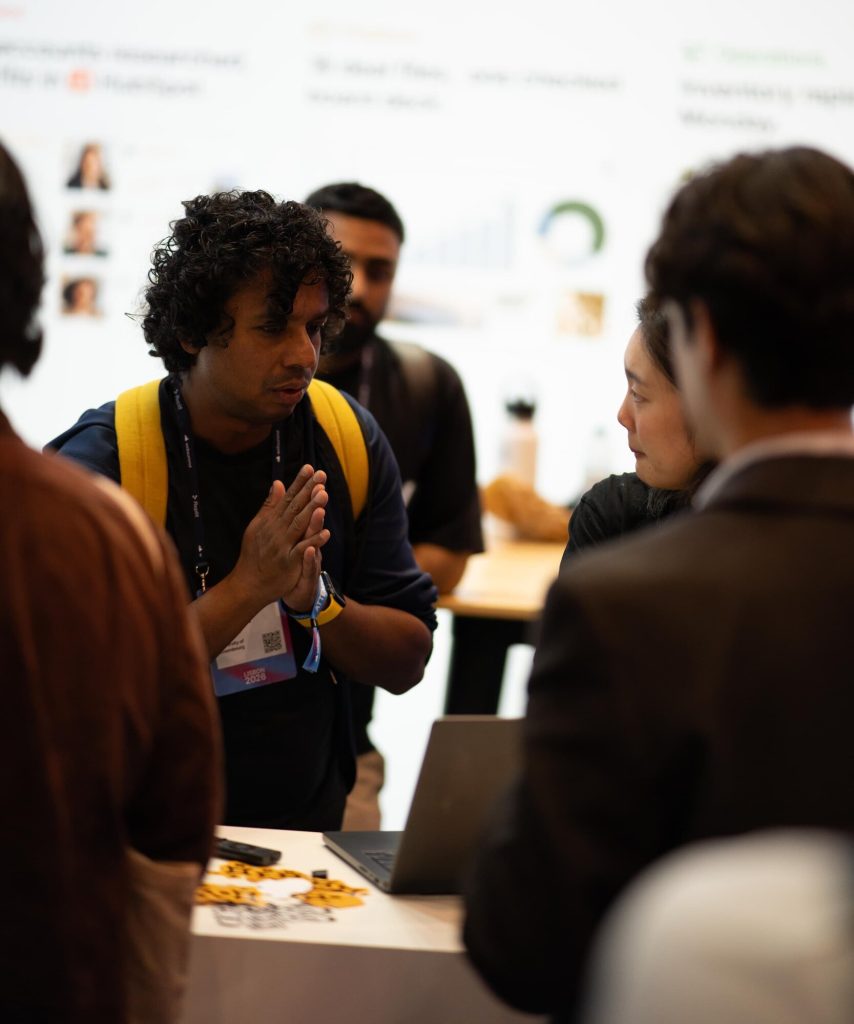
Siva was. A few years ago, he did a yellow photo shoot with me in Lisbon. We stayed in touch through social media, where I follow his amazing gift. This year he was working for Web Summit. He remembered me, photographed me without my knowing, and sent me the pictures days later.
I was surprised.
Stories like that, I could tell you tons. People are so kind to me. Guess what, I even got free food in Lisbon. (I guess this is part of my destiny.)
I am grateful to the Universe for all this kindness.
The shepherd
Now I feel like the shepherd in The Alchemist by Paulo Coelho.
I want to take my sheep, go up into the mountains, and write stories that I will read to them.
Because down here, the roles are reversing quickly.
Smile. Create. Inspire. 💛
Take Care,
Your fav Social Media Manager ☀️
Aswin
Photos of me in conversation by Prasad Siva, Lisbon photographer (Shootme Lisboa). All other photos are from my own phones. Storm and reopening details: Web Summit’s event update, The Irish Times, The Portugal News and Exhibition News.