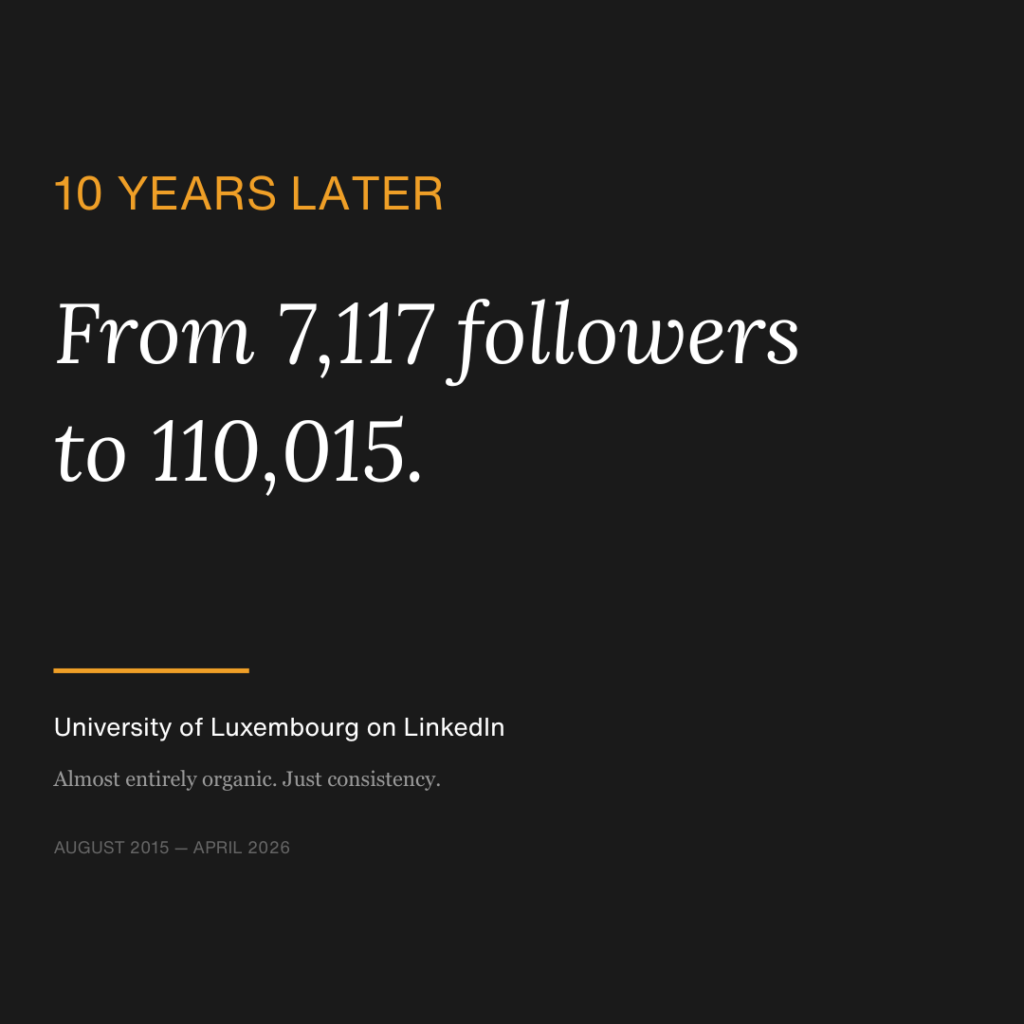
Almost entirely organic. Just consistency, voice, and the patience to write for the long term.
In August 2015, the University of Luxembourg’s LinkedIn page had 7,117 followers.
I had just joined as Social Media Manager. The number was small but honest, the page was modestly active, and the brief I was given was simple: post the news, hope for the best.
This week, almost eleven years later, the same page crossed 110,015 followers.
A worldwide audience, built from a public university in a country of roughly 700,000 people. Almost entirely organic. No virality. No shortcuts. Just consistency, voice, and the patience to write for the long term.
This is what ten years of showing up looks like.
A small country with a public university
When I started, the University of Luxembourg was twelve years old. The country itself had under 600,000 inhabitants. Most of the population spoke at least three languages, often four. Most of the workforce came from across the borders, every day, in three different cars and three different accents.
This was never going to be a story about doing what other universities did.
The big institutional accounts I looked at in 2015, the Sorbonne, MIT, Cambridge, operated at a scale and a register I could not replicate. They had centuries of identity. They had thousands of staff. They had budgets I would never see.
What we had was different. A young university with global research ambition, a multilingual audience, a cross-border workforce, and almost no inherited brand voice on social media. That was a constraint, but it was also a permission. We could decide what the page sounded like.
Early on, I made a quiet decision. The page would not always sound like an institution. It would sound like a person who happened to work at one.
Lesson 1: Consistency beats cleverness. Always.
Most people overestimate the impact of one brilliant post and underestimate the impact of one ordinary post, repeated for years.
When I started, I was tempted by the same thing every social media manager is tempted by: the big swing. The viral moment. The post that everyone shares.
It does not work. Not for institutions. Not over the long term.
What works is the boring rhythm of showing up when nothing is happening. A like to a researcher whose paper was published. A photo of a joyful moment on campus. A congratulatory comment to a student who graduated.
Each post on its own does almost nothing. Together, over a decade, they build a presence. They train your audience to expect you. They train the algorithm to trust you. They train you to write without waiting for inspiration.
Creativity is not the hardest part of social media. It is endurance.
In the beginning, there were entire months, when I wondered if any of it was working. The numbers grew slowly. The reactions were quiet. Nothing felt like a breakthrough.
Looking back from 110,000 followers, those quiet months were the breakthrough. They were the work.
The internet rewards endurance, not brilliance.
Lesson 2: A human voice beats a corporate one. Even for an institution.
The temptation of institutional social media is to write like an institution.
Polished. Formal. Cautious. Anonymous.
Nobody listens to that voice. Not because it is wrong, but because it sounds like nobody.
The audience can tell when a real person is on the other end of a post. They can tell when someone has chosen each word, when someone has hesitated over a tone, when someone is willing to let warmth into a sentence that the brand guidelines technically forbid.
A university is allowed to be warm. A university is allowed to be funny. A university is allowed to write like one of its own students would write.
The most successful posts I wrote in ten years were never the ones that sounded most like the University. They were the ones that sounded most like a person who happened to work at the University and genuinely cared about what they were saying.
This is harder than it looks. Writing like a person inside an institution requires you to keep two voices in your head at the same time: the personal one that wants to say something specific, and the institutional one that has to protect a brand. Most of the time those two voices argue. The trick is to let the personal one win, and to make sure what it says reflects well on the institution anyway.
After a while, you do not have to argue with yourself. The voice settles. It becomes recognisable. People start to know what your account sounds like even when you change the topic.
Institutions don’t follow institutions. People follow people.
Lesson 3: Trust compounds in ways impressions never will.
Social media reporting tends to focus on what is countable: impressions, reactions, comments, click-through rates. These metrics are not wrong, but they are the surface of the work. They are not the work.
The real returns of institutional social media are invisible at first, then suddenly large.
Over ten years, I have watched alumni come back to the page after disappearing for years. I have watched colleagues from other universities and Luxembourg private sector reach out for advice. I have watched former students send messages saying the page kept them feeling connected to Luxembourg long after they had left.
None of this shows up in a quarterly dashboard.
What shows up is a slow accumulation of trust. Trust that the page will be there next year. Trust that the voice will be familiar. Trust that what gets posted will be worth a few seconds of attention.
That trust is the most valuable thing an institutional social media account can have. It is also the thing most likely to be sacrificed for short-term engagement metrics. Once an audience stops trusting the voice, no amount of paid promotion will bring them back.
The followers who chose to stay for a decade did so because they decided, somewhere along the way, that the page was worth their attention. That decision was made quietly, in dozens of small posts they probably do not even remember.
Reach is rented. Trust is owned.
The next 100,000 starts today
Last week, when I posted about crossing 110,015 followers, I expected a few warm reactions and a quiet evening.
What I did not expect was the wave of messages from former colleagues, former students, people who had left the University years ago. Many of them said the same thing in different words. The page kept them connected. The voice felt like home.
That is the metric I will remember from this milestone. The proof that consistency, over time, builds something that lives outside the platform it began on.
If I have learned one thing in ten years, it is that institutional social media is not a job that ends. It is a relationship that deepens. Each year, the audience grows older with you. Each year, the work becomes a little less about getting attention and a little more about deserving it.
The next 100,000 starts today. Quietly, like the first 100,000 did.
Smile. Create. Inspire. ?
Take Care,
Your fav Social Media Manager ☀️
Aswin
P.S. If you feel like joining the conversation on the related LinkedIn post.